
Use your solar after sunset
Battery storage for homes on the Spanish coast
Solar generates at midday; most households spend the most at 8pm. A battery closes that gap — and keeps the lights and fridge on through a cut. We are straight with you about the maths: batteries pay back more slowly than panels, so they need to be sized on your real evening use.
Get a free storage assessment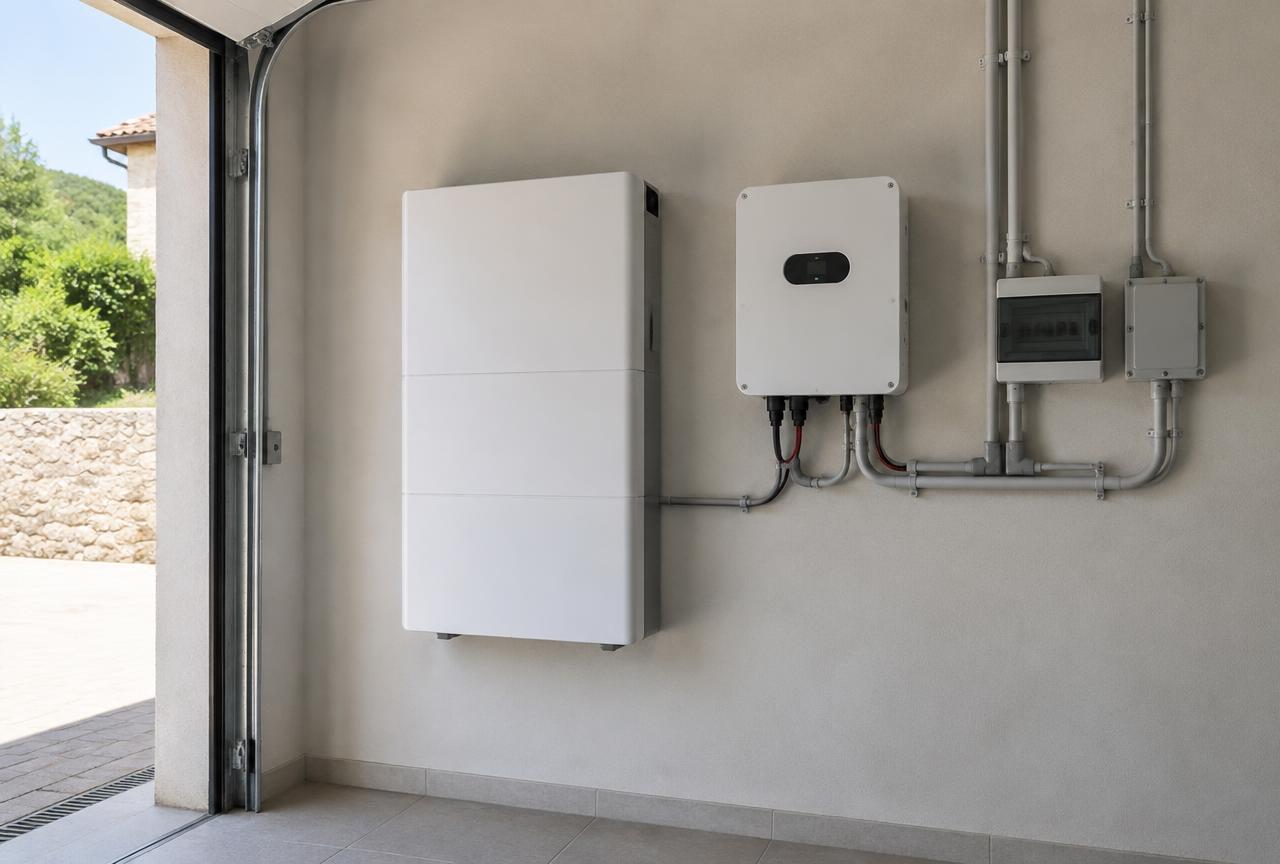
Battery costs and realistic savings
Installed lithium storage runs about €500 - €800 per kWh of usable capacity, fitted with a solar system. Savings below assume each stored kWh replaces grid electricity at around €0.22/kWh instead of being exported for roughly €0.06 - €0.09.
Swipe the table sideways to see every column.
| Capacity | Typical property | Installed cost | Energy shifted | Annual saving |
|---|---|---|---|---|
| 5 kWh | Apartment or small villa, low evening use | €3,000 - €4,000 | 1,400 - 1,700 kWh/yr | €230 - €330 |
| 10 kWh | Family villa, evening cooking and air conditioning | €5,000 - €7,500 | 2,700 - 3,300 kWh/yr | €450 - €640 |
| 15 kWh | Large villa, heat pump or pool plant, some backup | €7,500 - €10,500 | 3,900 - 4,700 kWh/yr | €650 - €900 |
On savings alone that is a 10 - 14 year payback against a 10 - 15 year warranty and 6,000+ cycles. The case improves sharply if you are on a time-of-use tariff and charge cheaply at night, if you are off-grid or on a weak supply, or if power cuts genuinely cost you something. If none of that applies, we will tell you to spend the money on panels or insulation first.
Two worked examples
Villa in Jávea · 6.5 kWp + 10 kWh
Solar alone covered about 60% of use. Adding 10 kWh lifted that to roughly 85%, worth around €560 a year on top of the panels. €6,400 for the battery, fitted the same week as the array.
Finca near Estepona · 15 kWh with backup
Rural supply with frequent short cuts. 15 kWh with backup circuits for water pump, fridge and lighting, €9,600 installed. The saving is real but the reason for buying was riding out the cuts.
What we check before quoting
Timeline from first call to stored power
Consumption review
We look at your hourly data from the distributor, not just monthly totals — that is what decides the right size.
Design and quotation
Battery capacity, inverter compatibility, where it will be mounted and whether you want backup circuits.
Installation
Alongside a new solar system, or retrofitted to an existing one. AC-coupled units fit most older installations.
Modification of the registration
Adding storage means updating your self-consumption paperwork. The system runs while that is processed.
Find out whether a battery is worth it for you
Send a recent bill and we will model your evening use, size the battery honestly and show the payback. Storage works best with solar panels and a well-insulated home — see insulation.